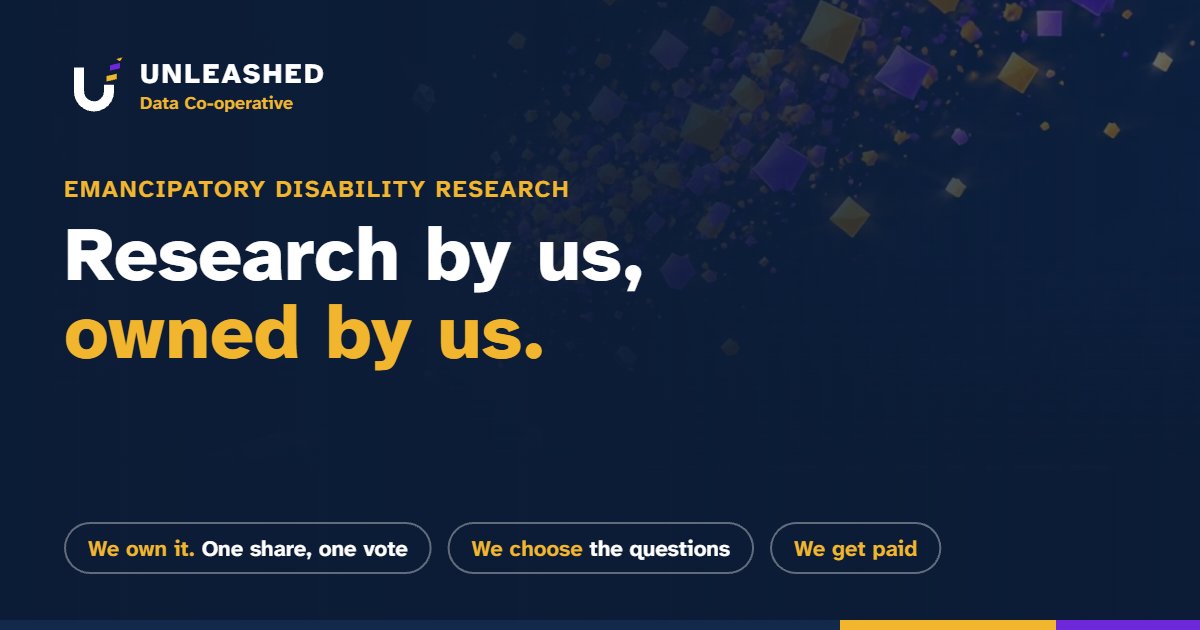
Research by us, owned by us
Disabled people have been researched for decades. We have filled in the surveys, sat in the focus groups and told our stories. Others decided the questions. Others owned the answers. Others built careers on them. We were rarely paid, and we rarely saw anything change.
Unleashed exists to turn that around.
A demand from the disabled people's movement
In 1981, Paul Hunt called the researchers who studied disabled people in institutions, and changed nothing, "parasite people" (Hunt 1981). It was an angry phrase. It was also accurate.
A decade later, Mike Oliver set out an alternative: emancipatory disability research (Oliver 1992). Colin Barnes, Gerry Zarb and others developed it (Barnes 1992; Zarb 1992). The idea was simple, and radical. Research should be part of the solution to disabled people's oppression, not part of the problem.
That meant four things:
- The social model. Study the barriers society puts in our way, not our bodies.
- Control. Disabled people and our own organisations decide what is researched, how, and what happens to the findings.
- Taking sides. Stop pretending to be neutral about discrimination. Be honest about whose side you are on.
- Gain. Judge research by what it changes in disabled people's lives.
It worked. The British Council of Organisations of Disabled People commissioned its own study of discrimination (Barnes 1991). That evidence helped win the Disability Discrimination Act 1995. Its research on direct payments (Zarb and Nadash 1994) helped bring in the Community Care (Direct Payments) Act 1996.
The part that never changed
Oliver talked about changing the social and material relations of research production. In plain words: who is in charge, and who owns and pays for it.
The social side shifted. Disabled people sat on advisory groups and shaped questions. The material side barely moved. The money still came from universities, government and charitable trusts. The data still belonged to someone else. And disabled people still gave their time and experience for free, while others were paid to collect it.
By the late 1990s, Oliver himself asked whether emancipatory research was "a realistic goal or an impossible dream" (Oliver 1997). Without control of the money and the data, it was always going to be hard.
How Unleashed changes the material relations
Unleashed is a data co-operative owned and run by disabled people. It changes the parts that never moved:
- We own it. Every member holds one £1 share and has one equal vote. There are no outside shareholders.
- We own the data. Our information belongs to the co-operative, on behalf of its members. Members decide together how it is used.
- We choose the questions. As well as doing paid work for councils, the NHS and businesses, members choose the services and barriers we investigate ourselves.
- We get paid. Every survey, interview and accessibility test is paid work. Our knowledge has value, and it stays with us.
This is not research done on disabled people, or even with disabled people. It is research by disabled people, owned by disabled people, and used for change.
Our Research Charter
We have written these principles into a Research Charter for our board to adopt. It commits us to the social model, to member control, to paying members, and to judging our work by what it changes. It also sets out the work we will turn down. Every client and research partner will be asked to sign up to it.
We are starting in Sunderland, with 100 founding members. If you are disabled and want your experience to count, and to be paid for it, join us at unleashed.coop.
Nothing about us without us. And nothing about us without paying us.
References
Barnes, Colin. 1991. Disabled People in Britain and Discrimination: A Case for Anti-Discrimination Legislation. London: Hurst and Company.
Barnes, Colin. 1992. "Qualitative Research: Valuable or Irrelevant?" Disability, Handicap & Society 7 (2): 115–124.
Hunt, Paul. 1981. "Settling Accounts with the Parasite People: A Critique of 'A Life Apart' by E. J. Miller and G. V. Gwynne." Disability Challenge 1: 37–50.
Oliver, Mike. 1992. "Changing the Social Relations of Research Production?" Disability, Handicap & Society 7 (2): 101–114.
Oliver, Mike. 1997. "Emancipatory Research: Realistic Goal or Impossible Dream?" In Doing Disability Research, edited by Colin Barnes and Geof Mercer, 15–31. Leeds: The Disability Press.
Zarb, Gerry. 1992. "On the Road to Damascus: First Steps towards Changing the Relations of Disability Research Production." Disability, Handicap & Society 7 (2): 125–138.
Zarb, Gerry, and Pamela Nadash. 1994. Cashing in on Independence: Comparing the Costs and Benefits of Cash and Services. Derby: British Council of Organisations of Disabled People.